Most marketing has a short life. A social media post scrolls away within hours, a flyer is often read once and a radio spot lasts seconds. A good calendar, by contrast, is looked at every day for a whole year. It hangs in kitchens, shops, offices and clinic reception areas, quietly reminding people of your name, your phone number and what you do. For Kerala businesses and institutions, a custom calendar is one of the few marketing pieces that customers genuinely ask for, and that makes it worth designing well.
Why calendars still work as marketing
A branded calendar succeeds because it is useful first and promotional second. People keep it because they need to check dates, plan events, track festival holidays or note down appointments. Every time they do, your brand is in front of them.
- Twelve months of visibility from a single print run, without ongoing ad spend.
- Repeated, everyday exposure in homes and workplaces, where other advertising rarely reaches.
- Goodwill: a calendar feels like a gift, not an advertisement, especially when handed over personally at the start of the year.
- Your contact details within reach whenever a customer needs to call or WhatsApp you.
- A canvas for storytelling: each month can showcase a product, a project, a value or a milestone.
- Strong fit with local culture, where wall calendars remain common in homes, shops and institutions.
Choosing the right calendar format
The best format depends on where your audience will use the calendar and how much you want to spend per piece.
| Format | Where it lives | Strengths | Consider |
|---|---|---|---|
| Single-sheet wall calendar | Shops, offices, homes | All twelve months at a glance; economical for large quantities | Limited space for imagery and notes |
| Multi-page wall calendar (6 or 12 leaves) | Homes, reception areas | Room for a new image or message each month or two | Higher print cost; binding and hanging method matter |
| Desk or table tent calendar | Office desks, counters | Stays at eye level of decision-makers; feels premium | Needs sturdy board and stand; smaller print area |
| Pocket or wallet calendar | Wallets, purses | Very low cost; easy to hand out at events | Tiny space; mostly a reminder of your name |
| Digital calendar graphics | WhatsApp, Instagram, phone wallpapers | Free to share widely; can be updated | Easily forgotten; works best alongside print |
Many organisations combine formats: a premium multi-page calendar for key clients and partners, and a single-sheet version for general customers, both sharing the same design language.
Plan the calendar around your audience and goals
Before opening any design software, answer three questions.
1. Who will receive it?
A wholesale distributor giving calendars to retailers needs something practical and robust. A school or college distributing to parents and alumni may want photographs of campus life and an academic schedule. A jewellery or textile store may want aspirational imagery that reflects its collections.
2. What should they remember?
Choose one primary message. It might be your phone number, a new branch, your range of services or simply that you are the trusted name in your area. Everything else supports that message.
3. Which calendar system matters to them?
Kerala audiences often use more than one calendar. Alongside Gregorian dates, many households look for Malayalam calendar months (the Kollavarsham year, which begins in Chingam around mid-August), and Muslim institutions and families often want Hijri dates. Including the right systems, clearly and accurately, can be the reason your calendar stays on the wall instead of a free one from somewhere else.
Tip: verify every holiday and festival date. Festival dates change each year, and dates based on the lunar calendar, such as Eid, may depend on moon sighting. Cross-check against the official government holiday list for the year and, where a date is not yet fixed, mark it as tentative. One wrong holiday can undermine trust in the whole calendar.
Design principles for a calendar people keep
Make the dates the hero
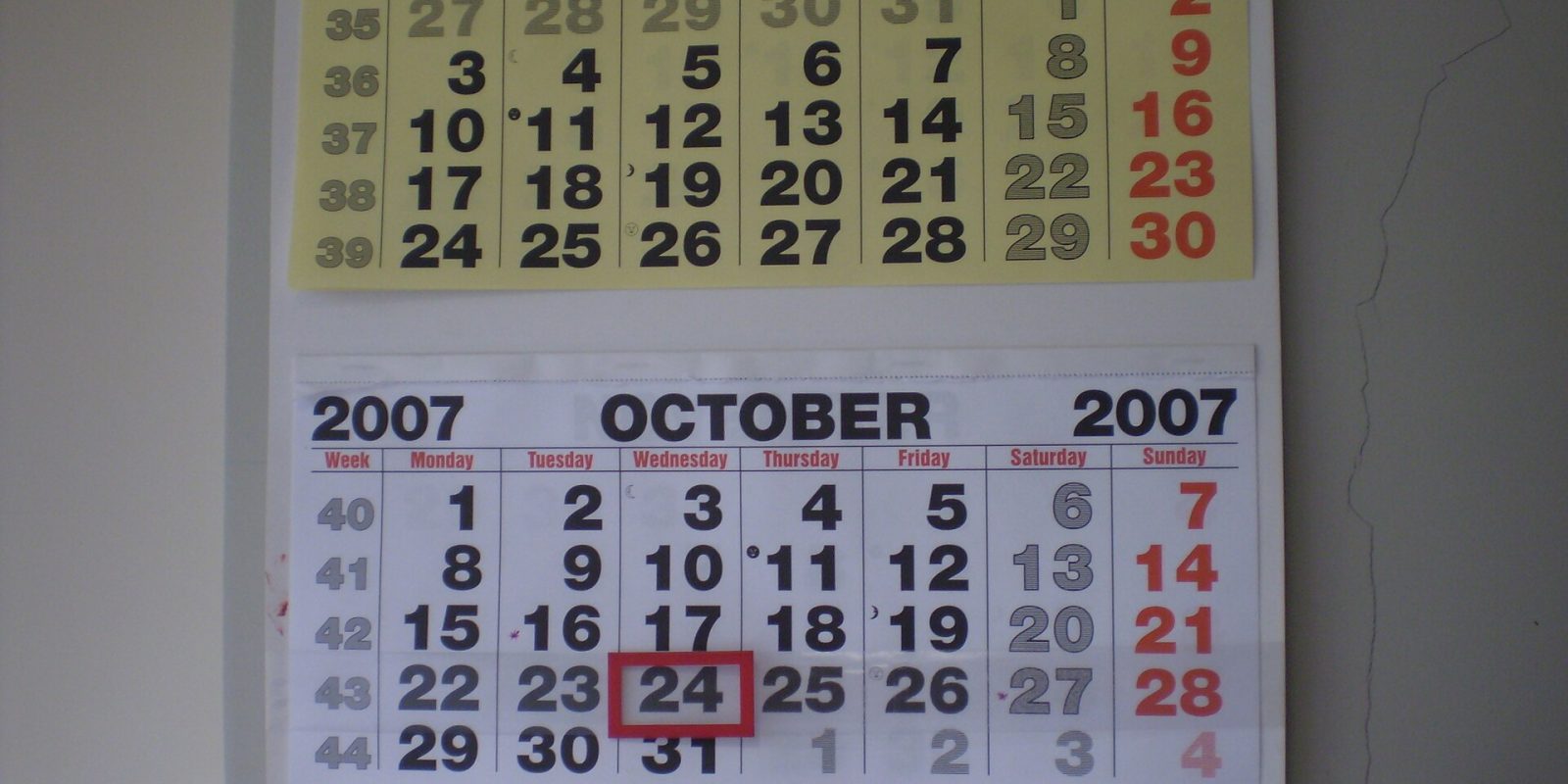
A calendar is a tool. Dates must be large, clear and easy to read from a few steps away. Sundays and public holidays should be distinguished consistently, often in a contrasting colour. Leave enough space in each date cell if people are likely to write notes.
Brand with confidence, not clutter
Your logo, name and contact details should appear on every page or prominently on a single sheet, but they should not fight with the dates. A consistent strip at the top or bottom of each page usually works best. If your logo needs a refresh before it goes on twelve months of print, our logo creation service can help first.
Use imagery with a theme
Strong calendars follow a theme: products in use, Kerala landscapes, your completed projects, staff and students at work, calligraphy, or seasonal festival illustrations. Use high-resolution images suitable for print; photos taken from social media or WhatsApp forwards are usually too small and may not be yours to use.
Plan for bilingual text
If you include Malayalam month names, festival names or a message in Malayalam, plan the layout so both languages sit comfortably. Malayalam text needs a little more vertical space, and it should be set in a proper Unicode or well-tested print font to avoid broken characters.
Think about the whole year
Map each month to a message before designing. For example, a business might highlight Onam offers in its August or September page, a wedding collection during peak wedding months and year-end services in December. An institution might mark admissions, exams, arts fests and anniversaries.
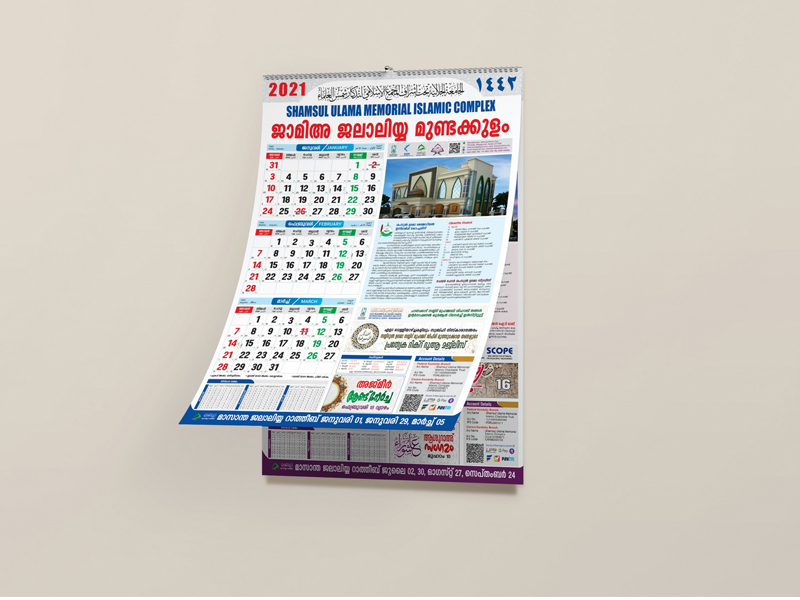
For a real example, the 2021 wall calendar we designed for Jamia Jalaliyya, Mundakkulam, appears in our portfolio alongside other print work.
Printing and production choices
The physical quality of a calendar affects how long it lasts and how it reflects on your brand. These are the main decisions to discuss with your printer.
- Size: common wall sizes range from compact sheets for homes to large formats for shops and offices. Consider where it will hang; very large calendars may not fit typical kitchen or office walls.
- Paper: a reasonably heavy art paper or board keeps pages from curling. Matte finishes are easier to write on; gloss makes photographs pop.
- Binding: wiro (spiral) binding lets pages flip neatly; a top metal strip with a hanging loop suits single-sheet calendars; desk calendars need a firm stand.
- Finishes: lamination or spot UV can highlight a logo or cover, but keep writing areas uncoated if you expect people to make notes.
- Colour accuracy: artwork must be prepared in print-ready colour with bleed, and you should check a printed proof, especially for brand colours.
- Packaging: if calendars will be couriered to clients, including those in the Gulf, plan sturdy tubes or envelopes.
Dzone Ads offers both calendar design and printing, so the design is prepared with the final paper, size and binding in mind from the beginning.
A practical calendar timeline
The biggest mistake with calendars is starting late. A calendar that arrives in the second week of January has already lost part of its value, as customers may have hung someone else’s.
| When | Task |
|---|---|
| September | Decide format, quantity, budget and theme; collect photographs |
| October | Confirm the year’s holiday list and calendar systems; write monthly messages |
| Early November | Design concepts, revisions and date proofreading |
| Late November | Final approval, printed proof and production |
| December | Delivery, packing and distribution before the new year |
If your calendar follows an academic year starting in June, or the Malayalam year starting in Chingam, shift this timeline accordingly so distribution happens before the first month begins.
Smart distribution ideas
A calendar only works if it reaches the right walls. Consider these approaches:
- Hand them personally to your best customers and partners with a short thank-you note.
- Give one with every purchase above a certain value during December and January.
- Deliver calendars to schools, clinics, offices and shops in your area where many people will see them.
- Send a matching digital version on WhatsApp and Instagram so customers can save it on their phones.
- Include a QR code linking to your website, WhatsApp or Google Business Profile.
How to tell whether your calendar is working
Calendars are harder to track than online ads, but you can still gather useful signals. Print a dedicated QR code that leads to a specific page or a WhatsApp chat with a pre-filled message such as “Saw your calendar”, and count how many people use it. Ask new callers how they found your number. Note how many existing customers ask for a calendar again next year; repeat requests are one of the clearest signs that the design was useful. Over two or three years, these small observations tell you whether to increase the quantity, upgrade the format or change who receives it.
Also notice where your calendar ends up. If you visit customers and see it hanging in their shop or office in June, it is doing its job. If it is nowhere to be seen, the design, format or distribution needs rethinking.
Common calendar mistakes
- Wrong or missing holiday dates, or holidays from the wrong year’s list.
- Dates so small or decorative that they are hard to read.
- Over-crowding each page with offers and logos until it looks like a flyer.
- Low-resolution photos that print blurry.
- Outdated phone numbers or addresses that stay on walls for a full year.
- Printing too late to distribute before January.
Key takeaways
- A custom calendar earns a full year of everyday visibility because it is genuinely useful.
- Choose the format based on where it will live: wall, desk, wallet or phone.
- Include the calendar systems your audience relies on, such as Malayalam months or Hijri dates, and verify every holiday.
- Make dates clear and readable, keep branding consistent and use a monthly theme.
- Plan paper, binding and finishes with your printer, and always approve a printed proof.
- Start in September so calendars are on walls before the year begins.
Frequently Asked Questions
How many calendars should we print?
Start from your list of key customers, partners and locations where the calendar will be displayed, then add a buffer for walk-in customers and late requests. Print costs per piece usually drop as quantity rises, so it often makes sense to round up a little.
Can you include Malayalam and Hijri dates?
Yes. We can include Malayalam month names and dates, Hijri dates or both, alongside the Gregorian calendar. Lunar dates are marked carefully, and tentative dates are clearly noted.
What is the best size for a wall calendar?
It depends on where it will hang. Homes and small offices suit moderate sizes, while shops and institutions may prefer larger formats that are readable from across the room. We can share samples to help you decide.
Should we use our own photographs?
Original photographs of your products, projects or people make a calendar more personal and avoid copyright issues. They need to be high resolution. Where you do not have suitable images, licensed photography or illustration can be used.
Is a digital calendar enough?
A digital version is great for sharing, but it is easy to forget on a phone. A printed calendar on the wall delivers daily visibility. Using both together gives you the best reach.
Want your brand on customers’ walls all next year? Share your idea, quantity and preferred format, and we will design and print a calendar worth keeping. Request a quote from Dzone Ads today.